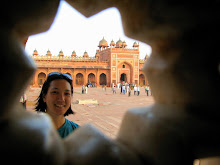
Grad school is affording few adventures to blog about lately, unless you want to hear about how the Republicans slashed family planning from the Medicaid portion of the stimulus package.
(What's that? You DO want to hear more! Here you go then...)
Lately my life extends from my bed to my desk to my kitchen to my toilet to my bed to my desk to my kitchen to my
In Kenya I started taking inventories of the food in my kitchen, so I could better plan meals, reduce food waste and save money. There's something satisfying about using every last bit of the goat that you never asked for, but that your well-meaning friend brought you as a gift. (Unfortunately, in the case of the goat, I tried to make wontons and ended up with a very pungent bowl of soup that reminded me of a petting zoo. Goat is gamey, make no mistake about it. I conveniently left it on my doorstep overnight "to cool", since I didn't have a fridge. In the morning it was gone, but in its place was a thank you note signed by a mongoose.)
Anyway, I've imported the inventory-taking habit back to the States with me, and have developed a rigorous system of meal-planning around it. Actually, last year my inventory-taking was occasional and recreational. I didn't become hard core about it until I got back from Thailand. When I moved back into my apartment in January, I found stuff sitting in the back of the fridge, or in the boxes I'd packed away for storage, and decided that if it was still good, I'd use it.
Some of it was easy. Grits, oatmeal, curry powder, spices, dried shitake mushrooms, rice. That sort of stuff doesn't go bad.
I also found some other stuff that seemed questionably promising. Mayonnaise? Olives?
The olives were probably still good, but there were a few white floaties in the jar, so I tossed them. They were purchased as garnish for martinis, and I figured that I might benefit from fewer of those this semester, at least until graduation.
It also turns out that despite mayonnaise being a code word for "lots of eggs that would normally go bad pretty quickly," my jar of mayo was still good. Apparently that's because mayonnaise also has enough preservatives to ensure a half-life of several centuries. Thanks to calcium disodium EDTA, I made a tuna salad last week and a potato salad this week.
It has actually been really nice to cook and eat exactly what I want, and not have to spend a fortune on it.
But first, a segue.
How much would you suppose this juice would cost?
Let's consider what you're getting in this 15.2 oz bottle of 100% juice. It actually tells you. Inside this bottle you will find: 30 blueberries, 8 blackberries, 3.5 apples and half a banana. Also you get an assortment of vitamins and minerals, and supposedly all the ingredients are natural.
The suggested retail price is between $3.19 and $3.79, not cheap.
I PAID $4.25!!!!
What's wrong with this planet? This is why poor people buy soda when they don't feel like drinking tap water. (Which, by the way, isn't filtered in New York. Very clean, but not filtered.)
Last I checked, people were still quoting the liar who said that health is a right, not a privilege. Tell that to the folks who designed our health care system, the only one in a Western developed nation that isn't nationalized and universal.
I've been studying my health policy notes too closely. Switching gears...
Tonight's dinner was a meal-planning, food recycling success story. It's almost like having my own Iron Chef show at every meal. I opened the fridge to find today's special ingredients:
a bowl of leftover chicken broth
white mushrooms, getting old
brown mushrooms, getting old
shitake mushrooms
tom yam soup mix in a jar
half a container of tofu fa* I bought in Flushing** last week, getting old
* a very very soft tofu that is usually eaten as a very very delicious dessert
** better Chinese food than anything you'll find on the island; try Jade Asian Restaurant for dim sum, but be prepared for a wait
I was inspired by this Korean tofu pot restaurant I went to in Ft. Lee, NJ, a few weeks ago. I don't remember the name, but I think it was this one. I don't have a ton of experience with Korean tofu, but it was the best I've ever had, by leaps and bounds. I'm accepting eating buddies to accompany me on a second visit.
Anyway, I had a Thai soup mix, not a Korean one; and Chinese style dessert tofu, not Korean soft tofu. But, throw it all together, add vermicelli noodles and a raw egg, and voila...
A ridiculously delicious recycled meal.
Monday, February 16, 2009
Recycling Is Edible
Posted by
Justina
at
6:57 PM
0
comments
Wednesday, February 4, 2009
Tuesday, January 27, 2009
Next Time I Will Procrastinate More Productively
So I've been a bit addicted to iGoogle, which is a customizable web page where you can get news feeds and other web content delivered to you in one place. They have some pre-designed templates ("themes") that you can apply to your iGoogle page for visual variety. This is their Classic theme, which I use for my home page:
I poked around a bit and found that someone had designed one for CARE International, and as you know (or maybe you didn't) I was doing my practicum last semester with CARE Thailand.
Anyway, I came upon some comments that people had posted about the template. The description given for CARE was this: "CARE fights global poverty by empowering women and girls to bring lasting change to their communities. Learn more at www.care.org."
It's from their website but I don't think it's their official boilerplate, because I know for a fact that their work doesn't focus exclusively on women and girls.
Anyway, someone had posted the following comment:
Charity for all... Anonymous - Jan 10, 2009 - Report this comment
Males are just as affected by famine and hunger as females. I don't understand this charity's preference and emphasis on the female sex (sexism?). Please explain.
I don't know why I bothered to explain, since the audience for the CARE iGoogle Theme Comments Page is probably even smaller than the one that reads my blog. Usually I write off infuriating comments as the gaseous by-product of ignorant commentators. But for some reason tonight I was compelled to explain. And quite politely, if I do say so myself.
Response to "Charity for all..." Anonymous - Jan 28, 2009
Actually males are not affected by famine and hunger the same way as females. Females, and girls in particular, are more vulnerable to natural disasters, disease, poverty, conflict and every other misfortune that life doles out in developing countries. They have a higher rate of HIV infection, lower levels of education, and fewer opportunities to earn money to support themselves and their families.
This is because in most cultures women and girls do not have the same social status as men. They are not valued as equal members of society. Many men in these cultures will tell you that women are property. They will tell you how many cows you should pay in order to get a wife.
In poor families, girls are passed over for education in favor of boys. Uneducated or poorly-educated females have fewer (no) opportunities to earn money. Without economic power they depend on their husbands for support. If these women do not have husbands or are widowed by disease or war, they're out of luck. If their husbands are abusive, drunk, unemployed or generally irresponsible, these women have no way to escape their situation. In many cultures a woman is blamed and/or rejected, often by her own family, if she tries to leave an abusive or exploitative marriage.
In many cultures, women do 90% of the work in a household (cooking, cleaning, fetching water, taking care of the kids, often even farming) but has virtually no say in how or when money is spent for the household - or when they get to have sex.
Without social status women do not have a public voice; they are not allowed to enter forums where the exchange of ideas occurs that bring about the changes that benefit them, their families, and their communities.
CARE does not "prefer" women/girls over men/boys; they simply know that giving women and girls the resources to support themselves and their family benefits the community as a whole - including men.
Having said that, if you go to their website you'll see that they have a broad range of projects, not just those targeting girls and women. http://www.care.org.
P.S. The light orange link color is hard to read. Please change.
Posted by
Justina
at
6:29 AM
3
comments
Monday, January 19, 2009
Subway Diaries
My friend runs a blog site called Muni Diaries in San Francisco that chronicles the oddities and the banal seen on the public transit system in the Bay Area. I just Googled for a similar concept here in New York, and got a few decent hits. The most compelling one, at a glance, is The Subway Chronicles, which I plan to peruse at some point in the next decade or so.
Anyway, I thought of this as I was riding the C train back home from my friend's place in Harlem tonight. There was an ancient, homeless-looking guy on my car who appeared semi-conscious or drunk, leaning at a 45 degree angle, mouth-breathing and staring at nothing. I walked towards his end of the car looking for an empty seat, but immediately spun around and headed to the other side of the car because he was steeped in pee. Nothing personal, I just didn't care to smell him for the next 50 blocks.
A few minutes later I noticed he was alert and smoking a cigarette, which has been illegal on New York subways for the last 500 years. Strangely enough, everyone on the car was staring at him. I mean every.single.person. No one was staring when he was just this crazy smelly old homeless guy half sleeping next to a spilled cup of coffee.
A woman started scolding him from across the aisle. "You can't smoke on the subway. You're going to have to put that out."
The man just nodded and continued smoking. He was clearly mentally ill and not grasping what she was saying. People started whispering and continued to stare. One woman coughed loudly, several people covered their noses with scarves, one guy rolled his eyes, and about half the people on the train shook their heads and turned their frowns even lower.
The man sitting next to me said, "You know, Obama has never mentioned anything about mental illness in his health care plan."
I wasn't sure if this was true or not, so I said something else that I wasn't sure was true or not. "Yeah, mental illness is one of those things that doesn't get prioritized in health care because people don't see it as a physical sickness."
"Oh my God," the man next to me said. "Now there's someone kicking that guy."
This was true. Someone had gotten on the train, taken one look at the dude smoking, and started kicking him.
I feel like rule number one on the subway is, don't kick mentally ill people. It's not nice, and not really safe either.
The kicker got off at the next station, and the homeless guy started ranting to himself. "Nggh mgh nngh I don't GIVE A SHIT! Fnggn ghnn nngh."
Then he took his cigarette and got off the train.
Posted by
Justina
at
11:07 AM
1 comments
New York Finally Recycles (Plastic Grocery Bags)
My subletter moved out and I settled back in to my old apartment last week. I opened the pantry to find a wall of grocery bags packed as tall as me. There were exactly two items in the whole pantry: plastic grocery bags, and an ironing board. I mean, how does that happen in the first place? I've never accumulated that many bags in my whole life, but I turn my back for one semester and you could film a horror movie in there.
All last year I asked around about where you can recycle these bags, and the answer was: You can't. You can recycle most other normal recyclables in New York, but not plastic bags.
It drove me crazy.
Fortunately, New York State recently passed a law requiring certain businesses in New York City to accept plastic bags for recycling starting January 1, 2009. This means that at larger grocery stores or chains there should be a clearly marked bin where you can return all those plastic grocery bags that have been accumulating in dark corners all over your kitchen.
Safeway in the Bay Area has had these bins for years. However, no one ever seemed to know about them, except me. Every month or so I'd take a huge plastic bag stuffed with plastic bags to Safeway, and people would always ask what the hell I was doing.
Anyway, now this brilliant idea has arrived in New York, but a lot of stores still don't have the bins. Stores are supposedly fined $100 a day for not having them, but there's either a grace period for compliance, or $100 a day is less of a burden for stores than figuring out where to get these recycling bins.
I'm happy to report that the Gristede's near me in Washington Heights is on top of their game, and has placed a bin right by the entrance, so now I can go in, dump my bags and not shop there, because their groceries are ridiculously expensive. But kudos to them for the bins.
The Fairway Supermarket on the Upper West Side has a bin, but most of their employees and managers don't even know about it. I finally found one manager who did, and he pointed me upstairs, to their organic food section where there were only about three customers milling about. My friend said to me today, "There's an upstairs at Fairway?" Not a good place for an item that is already so obscure in the consciousness of even the store's employees.
Since there's clearly a publicity and marketing person who's not doing their job on this plastic bag recycling campaign, I'm making it a point to tell everyone about it. (Also, if you'd like to fire that person and replace her/him with me, I do have a marketing background, excellent communication skills, and a fierce hatred of plastic grocery bags that don't get recycled.)
Another part of the problem is that I've only seen these bins with my own eyes in two places in the city. Let's be fair, though, I've only been back in town for a week. I hear that Whole Foods has them, if that's any help. The Rite Aid in my neighborhood doesn't have one, and the employee I asked about it didn't know what the hell I was talking about.
"You're looking for what? Outside. Just go outside."
So good to be back in New York.
---
If you find a listing of stores in New York that have these bins, send it my way.
Posted by
Justina
at
3:38 AM
0
comments
Saturday, January 17, 2009
Cold. Expensive.
I’m back in New York after five months in Thailand, three weeks in Texas and four days in San Francisco. Coming back wasn’t as painful as it was this time last year, when I contemplated dropping out of grad school mainly because it required me to live in New York. That’s as harsh a review of a place as you can get.
This time it was only painful in terms of regulating my body temperature. It was 23 degrees the day I flew into JFK, and today it was 16. I hear it’s much worse in the Midwest, but I’m not counting my blessings. I’m ungrateful for the fact that it’s not below zero. It’s so cold here that I get angry when I feel the outdoors coming to greet me when I exit the subway or my apartment. I feel violated by how cold it is. It offends me.
But, it does make me grateful for warm things, like a down coat, tall boots, my oddly large collection of SmartWool socks, and fuzzy slippers.
Yesterday I was at Fairway – an “inexpensive” grocery store in New York – and started getting angry. Avocados are $2. Apparently that really is cheap compared to Whole Foods, where they go for $2.50 or $3. I mean, who is stupid enough to pay that much for an avocado? The answer to that – a lot of New Yorkers – only leads me to the conclusion that I’m living in a city of 8 million stupid people. Which then makes me even more irritable, especially because I’m often stupid enough to pay ridiculous sums for ordinary items as well. I just dropped $10 on a tiny box of dried cranberries mixed with dried blueberries. Why? After all, raisins are so much cheaper, and taste much worse. But everyone succumbs to the insanity eventually.
Case in point: In Bangkok I would get annoyed whenever I’d come out of a BTS station and the person in front of me would be walking down the stairs slowly. I'd think, “What are you, a turtle?” Plus, everyone knows it takes way more energy to go down stairs slowly than to trot down and let gravity do the work. Anyway, why does any able-bodied young man or woman need to go slow? Don’t they have a life to get to?
That’s when I realized that New York had seeped into me, just a little. I remember arriving home from Kenya, stepping off the plane in Houston and noticing everyone speed-walking past me. In retrospect they were probably walking at a normal speed and I was walking slowly. But I do remember thinking, why is everyone in such a hurry? Are they so excited to get to immigration so they can stand in line?
----
Like everyone else in the United States of America, I resolved to exercise more in the New Year. Catherine, my brother’s girlfriend, pointed out that in order for resolutions to work, they must be quantified. For example, “I resolve to exercise twice a week.”
Well, more is a quantity. In my case, it means any number greater than zero.
Actually, I had the idea to use the current temperature to guide my workouts, because doesn’t everyone want to merge her disdain for winter with her disdain for indoor gyms? Today when I went to the gym it was 17 degrees outside, so I did 17 repetitions of everything – sit-ups, leg lifts, weights, etc. Sadly, 17 reps at a time are still too many for me. This is either a sign for me to get more fit – or hope for colder weather.
Wait. That can’t be right.
Posted by
Justina
at
9:17 AM
0
comments
Wednesday, December 31, 2008
Intro to Impermanence 101
My co-worker’s husband passed away in early December of lung cancer. He was really young, in his forties, and they have two kids in elementary school. They had a Buddhist funeral at a temple in Bangkok, with monks chanting and giving speeches in Burmese. A guy sitting next to me, a friend of the family, told me that the monks were talking about how life is impermanent and that we should be at peace with death.
At the end of the ceremony, a bunch of the male guests carried the coffin out to the crematorium, which was on the same compound. When I saw them carrying the coffin into the crematorium, my breath imploded into itself. It seemed so final, watching them go up the steps with the coffin, knowing that soon there would be nothing left of the guy except memories and photos.
It also seemed too soon. He had only passed away the day before.
I looked over at my co-worker, his widow, who was keeping it together really well. She and the kids just watched matter-of-factly. Maybe it’s because they are Buddhist, and when you’re Buddhist you know that cremation is part of how you die.
Even though a lot of people in the U.S. get cremated these days, I think the idea of burial and keeping the body around is pretty ingrained in us. I see it as one of the ways our culture tries to avoid the impermanence of everything in life, including life itself. At that moment, surrounded by all my Thai and Burmese co-workers, nearly all of whom are Buddhist, I felt like the least enlightened person in the crowd, with a knot in my stomach knowing that this guy was soon to be a pile of ashes.
Someone flipped a bunch of switches in the crematorium and there were these dramatic whooshing sounds, like pilot lights for a massive, industrial-sized stove. The fire was going. I think that most Asian cultures are all about not showing emotions, which added to the discomfort I felt with everyone around me watching almost impassively as the carriers slid the coffin into the, well, oven.
There was a tray of straw flowers at the foot of the steps leading into the crematorium. One by one we each took a flower and filed into the building. We put our flower into the fire next to the coffin, which was still intact except for a black spot that was starting to grow as one corner caught fire and burned. People wai'd the deceased as a show of respect, placing their hands together in front of their face in a prayer gesture. We continued out the door on the opposite side of the crematorium.
I asked another co-worker, our HR director, how long it usually takes for the cremation to be complete. I’m pretty sure I had to rephrase the question a few times. “How long does it usually take to burn the body? To burn away the coffin? How long does it take…ugh.”
“A few hours,” he said kindly. Thank God Thai people are so polite.
One reason I had asked was because even though the crematorium had been built with a tall chimney, I wanted to make sure to leave the compound before I started thinking there was someone selling barbeque from a food cart. Terrible. Terrible. Terrible.
Posted by
Justina
at
10:40 PM
0
comments
Thursday, December 25, 2008
Dogs In Taiwan
I was telling my parents about the proliferation of soi dogs in Thailand. At the risk of perpetuating stereotypes about alternative Asian cuisine, I'm following up my last post with my parents' response.
"Years ago, when I was still in Taiwan, you'd never see stray dogs anywhere."
"Why not?"
"People were hungry. They'd catch stray dogs and eat them."
"Really? I thought white people just made that up about Asian people."
"No. Even your dad, when he was in the military, his friends would catch dogs and eat them."
"No, no," my dad said. "Not everyone. Just the officers. They'd never share it with the regular soldiers."
"So, I mean, you'd catch the dogs and then grill them over a fire?"
"No," my mom said. "Stew."
"They'd catch the dog and then chop chop chop," my dad said, chopping at the air with his hands.
"But stray dogs are so skinny," I said, always being practical. "What's there to eat?"
"Better than nothing."
Now I'm in the mood to watch that episode of King of the Hill when the Laotian family moves in next door and their pet dog escapes from the yard. As the wife frantically calls the police to report their dog missing, Peggy spies on them through the window. She sees her strange Asian neighbor in the middle of making dinner, chopping meat while she's explaining the situation to the police.
"Dog!" she says into the phone. "Run out!"
Posted by
Justina
at
11:08 PM
0
comments
Monday, December 22, 2008
The Miss List
I’m flying home! My five months in Thailand have also flown by, commemorated only by this rather spotty chronicle of my time here.
The last few weeks I’ve kept a list of things I’ll miss about Thailand.
The only things I felt like I left behind in Kenya were friends. Everything else I was happy to see becoming a progressively smaller dot on the African landscape behind me, getting more wavy and distorted through the trail of jet fuel from the plane as we barreled down the runway towards the US.
Overall Thailand has been much more livable. I didn’t have the same level of cultural immersion as I got from living in an African village, but I also didn’t emerge with the frayed edges of sanity poking through my sweater at awkward angles.
Things I’ll miss about Thailand:
1. I won’t dwell on the obvious: friends. I met some really great people and each of them touched me in their own way. Like all good friends should.
2. The way Thais treat animals. In the States we’d want to vomit a little, because many Thais treat their pet dogs and cats like kids, combing them daily and even dressing them up in barfy clothes with ruffles and ribbons. I came here with the expectation that Thais, like people in many Asian cultures, value animals for their utilitarian worth and not for the companionship and affection they can provide. I assumed that they believed that dogs and cats belong outside and should be grateful for scraps to eat.
In Kenya most people treated dogs and cats like, well, animals. Beating the family dog, keeping him chained up all day, feeding him household waste destined for the garbage pit, beating orphaned kittens on the head with a metal spoon, and throwing rocks at any animal that wandered into a human dwelling were all appropriate ways to treat things with four legs.
So in contrast, seeing Thai people carry puffy toy dogs in their motorcycle basket or letting them ride standing with their hind legs in their owners lap and front paws on the handlebars was pretty heart-warming. Most pet dogs and cats don’t cower and shuffle away when you lift your hand over their head, because they don’t expect to get beaten all the time.
Also, most people in Thailand can claim to have “soi dogs,” or strays that hang out on the lane (soi) where they live. It’s not clear whether these dogs technically qualify as strays since many of them are fed and taken care of by people who live on the soi. No one will claim ownership for the dogs or allow them inside their houses, but everyone makes sure the dogs are well cared-for. At the same time, they bark and fight all night, spreading mange and doggy STIs to each other. One of my first observations when I got to Thailand was that the country needs public health for dogs. Part of the problem is that people feed their soi dogs, so they stay healthy enough to reproduce, ensuring future generations of mangy but loveable strays sleeping like speed bumps on your street all day.
One of my friends says that her soi dogs are really intelligent. I suppose it makes sense if you’re going to survive as a stray in Bangkok. She says that when her soi dogs walk out to the main street, which is a two-way multi-lane thoroughfare, they look both ways before crossing the street. How can your heart not melt seeing that?
I think it puts their IQ higher than some American politicians we’ve known lately. Look both ways before invading a foreign country.
4. Cheap stuff. I suppose it’s not hard to beat out New York City when it comes to having cheaper stuff (or more charm, smaller rats, and friendlier people for that matter).
This was a mixed blessing, though. You usually get what you pay for in Thailand. If a bowl of noodles is 30 baht ($1), it’s not enough for a decent meal. If a pair of flip flops is 59 baht ($2), it won’t survive more than a week of hoofing around in Bangkok. If a cotton shirt is 180 baht, it’s not cotton. But, hunt around for awhile and you start to learn where the bargains are. Plus, $580 gets you a really nice, furnished one bedroom apartment in a centrally-located neighborhood, with a real kitchen and space to lay down a yoga mat in front of the TV or have drinks with a friend or two on the balcony. Three thousand dollars doesn’t even get you that in New York.
5. Obviously, the food. Although I’m a bit tired of Thai food for now, and just asked my mom to have a pot of spaghetti sauce waiting for me when I get home tomorrow, there are certain dishes that just won’t be the same back in the States. One of them is pad thai. The only thing that makes pad thai worth eating, in my opinion, is the sliver of baby banana and sprigs of Chinese chives that come on the side. In the States, they only give you bean sprouts.
Also, Thai food in the States isn’t properly spicy. I’m not even sure if most American Thai restaurants have that four-flavor spice rack that every self-respecting food establishment in Thailand has, the one with 1. chili powder (hot), 2. chilies in vinegar (sour), 3. sugar (sweet), and 4. fish sauce (salty).
And finally, Mahachai was THE place for cheap, fresh-off-the-boat seafood. One night I bought two fat crabs and devoured them both all by myself. I have to admit, though, it was a bit difficult to hear them tapping frantically inside the pot as I steamed them to a sweet, rich tenderness.
Posted by
Justina
at
3:31 AM
2
comments
Tuesday, December 2, 2008
The Protests
The protests are over. Tomorrow at 10am, the anti-government People’s Alliance for Democracy (PAD) have agreed to vacate both airports in Bangkok. Cargo flights are scheduled to resume, and passenger flights within the next few days.
Read up on it here.
It’s a complex situation with a political history that goes back for years – arguably a decade or more.
It’s been tense the last week or so, and although someone could easily change their mind, I feel like after tomorrow things will settle down for the most part.
Mostly I’m left with the observation that the way a country asserts and responds to civil disobedience is such a window into their culture. In many ways I found the protesters’ behavior, and the government, military, police, ordinary citizens and opposition groups’ responses to it to be very Thai.
What struck me as very Thai was the generally non-confrontational nature of the whole protest. In nearly five months of illegally occupying government buildings and essential transportation infrastructure, only two people were killed. This is of course two people too many, but considering the number of people involved, and the fact that the police and military were repeated called upon to do something to disperse the crowds (but didn’t), this is quite impressive. This is not to say that things have been peaceful. Just not as violent as they would be in most other countries.
But this is what also strikes me as very Thai: Throughout the protests, the armed forces were reluctant to do anything. The government would issue a weak order for the military to do something, and in response the military would issue a statement saying they weren’t planning to use force anytime soon.
It was similar with the cops. The (now former) prime minister told the police to shoo protesters out of the airport, and the police announced that the protesters should leave the airport, but nothing happened.
My favorite headline, from The Nation, reads, "Police to launch psychological warfare to weaken public support for PAD."
Psychological warfare? Some friends and I had a good laugh about that.
“You mean everyone’s going to be very passive aggressive from now on?”
“Yeah, everyone’s saying, ‘I’m not talking to you anymore, so there.’”
“Or they’re like, ‘Hehehe. I’m going to tell them yes when I mean no.’”
It turns out police were just going door-to-door telling ordinary citizens not to get involved with the protests. Still, this is what they refer to as taking action?
In some situations, Thai people are known to react calmly, or not very much at all. When you’re backpacking around the country on vacation, this is called The Locals Are So Friendly And Laid Back. When they’re your work colleagues, this is called Cross-Cultural Frustration.
Thai people strive to achieve or maintain jai yen, or a cool heart, based on the Buddhist principle of acknowledging the impermanence of all things in life and therefore remaining detached from things that ultimately don’t matter, like replying to emails or meeting deadlines. It’s a very enlightened view of the universe, but not very practical for working with unenlightened Westerners who want to get things done every once in awhile.
All judgments aside. Well, some judgements aside. Despite some very tense moments, especially during the last week, and a few explosives-related casualties, the overall mood of the protest seemed very jai yen. No one was really itching to physically harm anyone else. The police weren’t too interested in getting injured in the name of defending the rule of law.
There was also the reaction of the general populace during this whole conflict. In the beginning, PAD had a lot of popular support, especially among the educated elite and urban middle class. Bangkok, basically. A pro-government (anti-PAD) group organized itself and became vocal in the past week, with a lot of support from rural areas of the country.
As PAD’s airport occupation wreaked havoc on broad sectors of the economy without appearing to achieve anything, they started losing support. Thais who formerly supported PAD for their anti-Taksin and anti-corruption stance began to get irritated. They had viewpoints that weren’t represented by either PAD or the pro-government protesters. But where was their voice? I didn’t hear of anyone trying to organize a third movement. Maybe something was brewing and I didn’t hear about it. Oe maybe everyone was jai yen. Get pissed off, but then detach. All life is impermanent.
In contrast, how would this have played out in the US? A group of armed citizens take over an international airport and demand that the president step down? I’d say the city’s mayor would speed dial his riot police, and in 45 minutes they would’ve cleared the scene of every last protester and their farts. What does this say about American culture? That we’re results oriented? That we like to throw our (rather obese) weight around every chance we get, especially when it involves firearms? Or that we value the rule of law – and not getting sued – above most everything else?
Oh. Maybe you should scratch all that. Here’s a much more insightful, well-argued explanation, which got this issue of the Economist banned in Thailand:
A Right Royal Mess
And the response that appeared in the Bangkok Post:
An Open Letter In Reply...
Posted by
Justina
at
6:54 AM
0
comments